 Anglo-Nubians, also known as Nubian (USA), were developed in England by crossing British goats
with bucks of African and Indian origin. The Anglo Nubian is an all-purpose goat, useful for
meat, milk and hide production. It is not a heavy milk producer but has a high average butter
fat content (between four and five percent). The Anglo Nubian breeding season is much longer
than that of the Swiss breeds so it is possible to produce milk year round.
As it is the best suited of the dairy goat breeds to hot conditions, the Anglo Nubian has been
used in grading-up programs in many tropical countries to increase the milk and meat production
of local breeds. The Anglo-Nubian is a relatively large, proud, and graceful dairy goat. The
Anglo-Nubian goat is named for Nubia, in northeastern Africa. The original goats imported
from Africa, Arabia and India were long-legged, hardy goats that had some characteristics
desired by goat breeders in England. English breeders crossed these imported bucks on the
common short-haired does of England prior to 1895 to develop the Anglo-Nubian goat.
Anglo-Nubians, also known as Nubian (USA), were developed in England by crossing British goats
with bucks of African and Indian origin. The Anglo Nubian is an all-purpose goat, useful for
meat, milk and hide production. It is not a heavy milk producer but has a high average butter
fat content (between four and five percent). The Anglo Nubian breeding season is much longer
than that of the Swiss breeds so it is possible to produce milk year round.
As it is the best suited of the dairy goat breeds to hot conditions, the Anglo Nubian has been
used in grading-up programs in many tropical countries to increase the milk and meat production
of local breeds. The Anglo-Nubian is a relatively large, proud, and graceful dairy goat. The
Anglo-Nubian goat is named for Nubia, in northeastern Africa. The original goats imported
from Africa, Arabia and India were long-legged, hardy goats that had some characteristics
desired by goat breeders in England. English breeders crossed these imported bucks on the
common short-haired does of England prior to 1895 to develop the Anglo-Nubian goat.
 In the United States the breed is usually spoken of as the Nubian. The Anglo-Nubian is regarded
as an "aristocratic" appearing goat and has very long, pendulous ears that hang close to the
head. The Anglo-Nubian carries a decidedly Roman nose and is always short-haired. Any solid or
parti-colored coat is permitted in the Anglo-Nubian, but black, red or tan are the most common
colors, any of which may be carried on combination with white. Usually there is shorter hair on
the Anglo-Nubian males, particularly along the back and on the thigh, than is commonly found on
the Swiss breeds.
In the United States the breed is usually spoken of as the Nubian. The Anglo-Nubian is regarded
as an "aristocratic" appearing goat and has very long, pendulous ears that hang close to the
head. The Anglo-Nubian carries a decidedly Roman nose and is always short-haired. Any solid or
parti-colored coat is permitted in the Anglo-Nubian, but black, red or tan are the most common
colors, any of which may be carried on combination with white. Usually there is shorter hair on
the Anglo-Nubian males, particularly along the back and on the thigh, than is commonly found on
the Swiss breeds.
The udder of the Anglo-Nubian is capacious but is sometimes more pendulous than that of the
Swiss breeds. A mature doe should stand at least 30 inches at the withers and weigh 135 pounds
or over, while the males should stand at least 35 inches at the withers and weigh at least 175
pounds. The Anglo-Nubian usually gives less milk than the Swiss breeds, but produces a milk of
higher butterfat content.
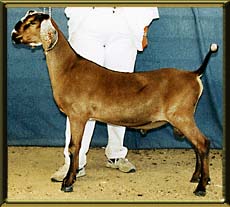
The head is the distinctive breed characteristic, with the facial profile between the eyes and
the muzzle being strongly convex. The ears are long (extending at least one inch beyond the
muzzle when held flat along the face), wide and pendulous. They lie close to the head at the
temple and flare slightly out and well forward at the rounded tip, forming a "bell" shape. The
ears are not thick, with the cartilage well defined. The hair is short, fine and glossy.
Any color or colors, solid or patterned, is acceptable.
Reference:
Briggs, Hilton M and D.M. Briggs. 1980. Modern Breeds of Livestock. Forth Edition, MacMillan Company
Mason, I.L. World Dictionary of Livestock Breeds. Third Edition. C.A.B International. 1988
Handbook of Australian Livestock, Australian Meat & Livestock Corporation,1989, 3rd Edition
Promotional Materials. American Dairy Goat Association, PO Box 865, Spindale, NC 28160. Phone: 704-286-3801

 |
 |
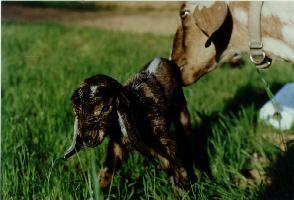
| New arrival at Water Oak Farms |
Proud Papa |
This page is
This page was last edited on Saturday, December 18, 2004
|

